Race Recap
Race Recap: Dark Skies 100K
Two years ago, my first ultra fell apart at mile 26. Last weekend I lined up at midnight in the rain to see how much had changed.
Jason Schmitt
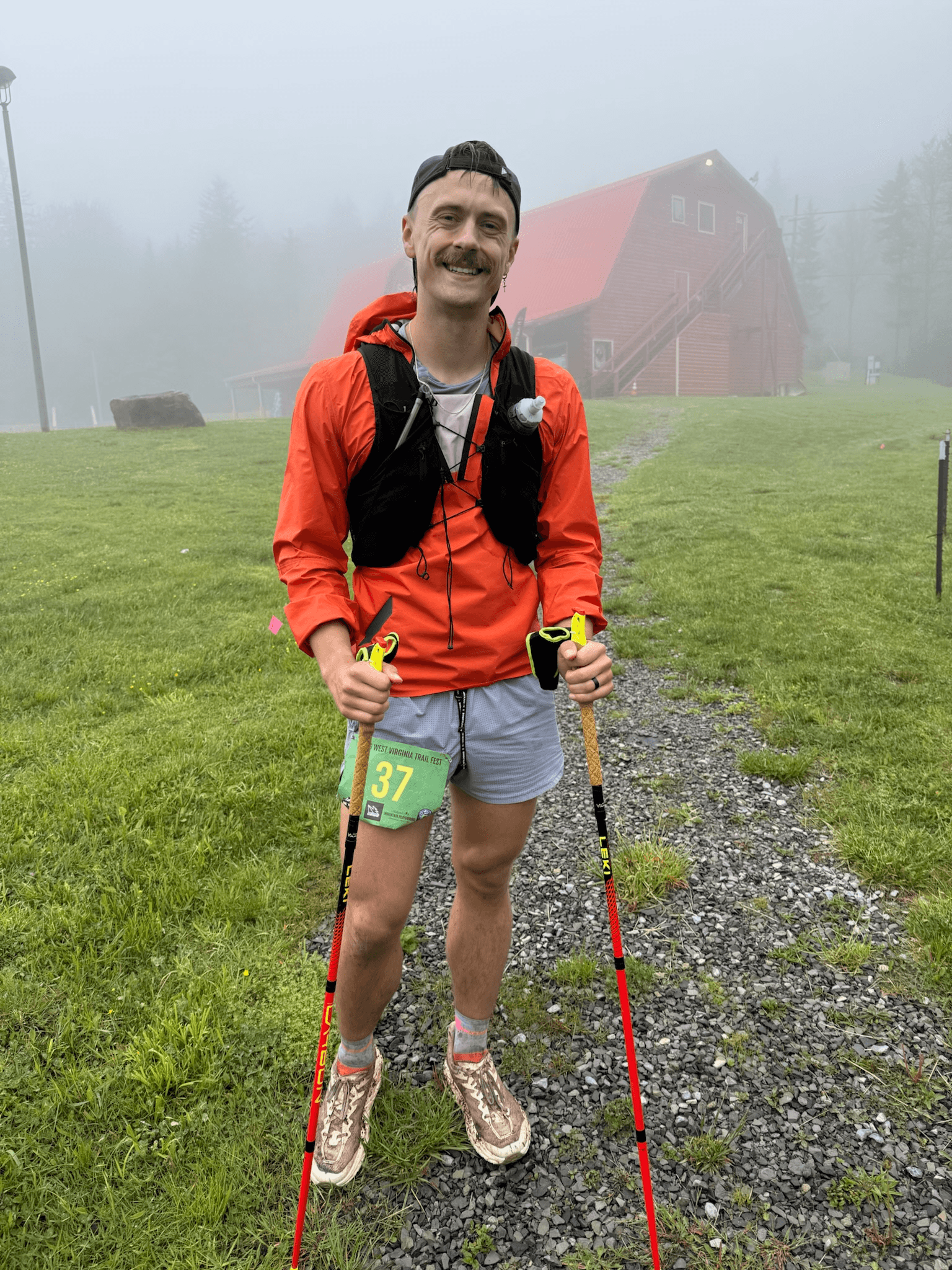
The Race at a Glance
Race: Dark Skies 100K — the long course at the West Virginia Trail Fest
Where: Pocahontas County, West Virginia. Point-to-point from Seneca State Forest, finishing up at Snowshoe Mountain.
When: Started 12:03 AM, Saturday, May 23. A true midnight start.
Distance: 62.11 miles Elevation gain: 11,148 feet
Conditions: Rain most of the way. Mid-40s to low-50s, 93% humidity, soaked trail from the first step to the last.
Finish: 16:29:37 elapsed (15:27:30 moving)
Overall pace: 14:56 per mile
Shoes: HOKA Speedgoat
A few things are worth knowing before the recap. This is a backcountry race in the truest sense, run through the mountains of Pocahontas County and finishing up at Snowshoe Mountain, the ski resort that anchors this whole corner of West Virginia. The start sits deep in the National Radio Quiet Zone, the protected stretch of land around the Green Bank Observatory where radio transmissions are restricted by law, which means for roughly the first 40 miles there is no cell service at all. You are genuinely off the grid, in the dark, in the mountains, with the occasional far-off glow of the observatory as the only sign of the modern world.
The course throws everything at you. Fire road, crushed gravel, technical single-track, a couple of short stretches of actual pavement, marsh, and creek crossings deep enough to soak you to the waist. There are long sustained climbs and long technical descents, and on this particular weekend the rain turned a lot of it into something closer to a mud luge than a trail. The whole festival is based out of Snowshoe, so the finish climbs right up the ski slopes to the village at the top of the mountain.
I was also running it for a reason. Two years ago I ran my first ultra, Looking Glass, and it went about as badly as it could go. So this was a rematch.
Why I Was Really Out There
My first ultra was a lesson in how not to run one. It was around 60 miles with roughly 12,000 feet of climbing, and I showed up with a race plan that amounted to good intentions and a lot of confidence. I took the early flats and downhills far too hard, and by mile 26 I had nothing left. My legs were cramping everywhere. At that point in my running I hadn't yet figured out that I'm a heavy, salty sweater who needs a serious amount of sodium just to keep my muscles firing, and I hadn't figured out how much I needed to be eating to keep the engine running either. So I blew up early and spent the next 34 miles grinding through it, parking myself at aid stations for twenty and thirty minutes at a time, just trying to survive to the finish. It took me just under eighteen hours, and when it was over I told everyone within earshot that I was never doing that again.
Dark Skies was the answer to that day. Not a rematch against the course, but against the version of me that showed up to Looking Glass underprepared and overeager. The whole plan came down to one idea that I repeated to myself like a mantra in the weeks leading up to it: come out softer than you think you should. Get through the first 40 miles in control. Then see what's left for the last 20. After a spring built around the Shamrock Marathon in March and a peak block that culminated in pacing a friend at the Garmin Durham Marathon, I tapered down, kept the legs fresh, and drove up into the mountains ready to run a patient race for once in my life. If you've ever wondered why so much of smart training comes down to restraint, this race is the clearest case I've ever made for it to myself.
There was a fun wrinkle, too. My brother Adam was running the 50K at the same festival, on what was essentially the back half of my course. His race started where mine hit the halfway point. So we had a little brother-versus-brother thing going, with one obvious catch: he started at 7 AM and I started at midnight, so the only way to settle it was the clock. More on how that turned out later.
The Build-Up
We headed up on Thursday in my brother's fifth wheel, a seven-hour haul through rain that did not let up the entire drive, and parked at the campground at the base of Snowshoe. The rain that soaked the drive never really stopped all weekend, with clouds rolling straight through the mountains around us. It was gorgeous in a moody, you-are-definitely-about-to-suffer kind of way. We got settled in, ate some pizza, and watched the Carolina Hurricanes get blown out in game one of their series, which set a questionable tone for the weekend.
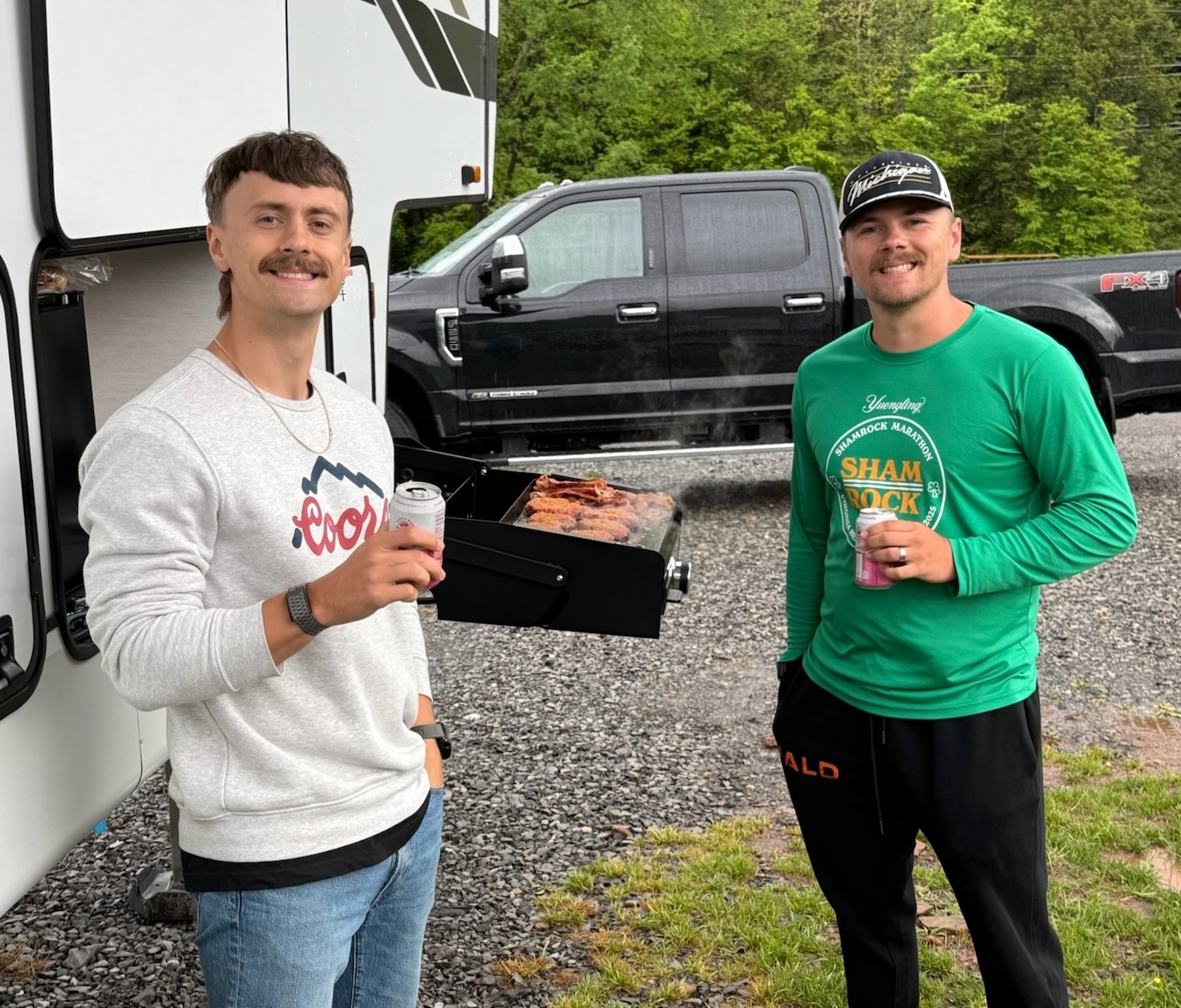
Because I started at midnight, Friday was technically race day, which made for one of the strangest pre-race days I've had. With nothing to do but wait, we pulled the seats out in the RV to turn it into one big bed and watched movies all day. Billy Madison, The Great Outdoors, which felt a little too on the nose for what I was about to do, and a couple of others I've half-forgotten. One real advantage of an ultra over a marathon is that you can loosen up on the diet. No need for the rigid white-rice-and-soy-sauce routine I'd run before a fast road race. I just ate things I knew would sit well, grilled some burgers, and tried to relax. I attempted to sleep from about 6:30 to 9:30 in the evening, eye mask on, and could not manage a single minute of it. I wasn't really expecting to. My brain was already 62 miles down the trail. So I got up at 9:30, ran through my stretches, had a banana and some light snacks, took my ketones and a little Tailwind, and caught the ride up the mountain to the shuttle.
A Midnight Start in the Rain
The shuttle ride to the start told me everything about where I stood in the pecking order. Somewhere on that 45-minute drive through the dark, the conversations going on around me made it very clear that I was one of the least experienced people on the bus. The guys to my left and right were trading hundred-miler stories. One of them had another hundred coming up. When somebody asked what I'd run, my honest answer was that the furthest I'd ever gone was a shortened 100K two years ago that came out closer to 59 miles, and that I'd run beyond the marathon distance maybe four times in my life.
And I loved it. There's something clarifying about being the least qualified person in the room. Nobody is expecting anything from you, which means the whole day is upside. You get to go out and find out exactly how you stack up against people who take this seriously, with no scoreboard pressure and nothing to defend. By the time we lined up at the entrance to Seneca State Forest, in the pitch black, in the rain, at the stroke of midnight, I wasn't nervous. I was just genuinely happy to be there, curious about all the uncertainty stretched out ahead of me, ready to spend the next sixteen-plus hours finding out what I was made of.
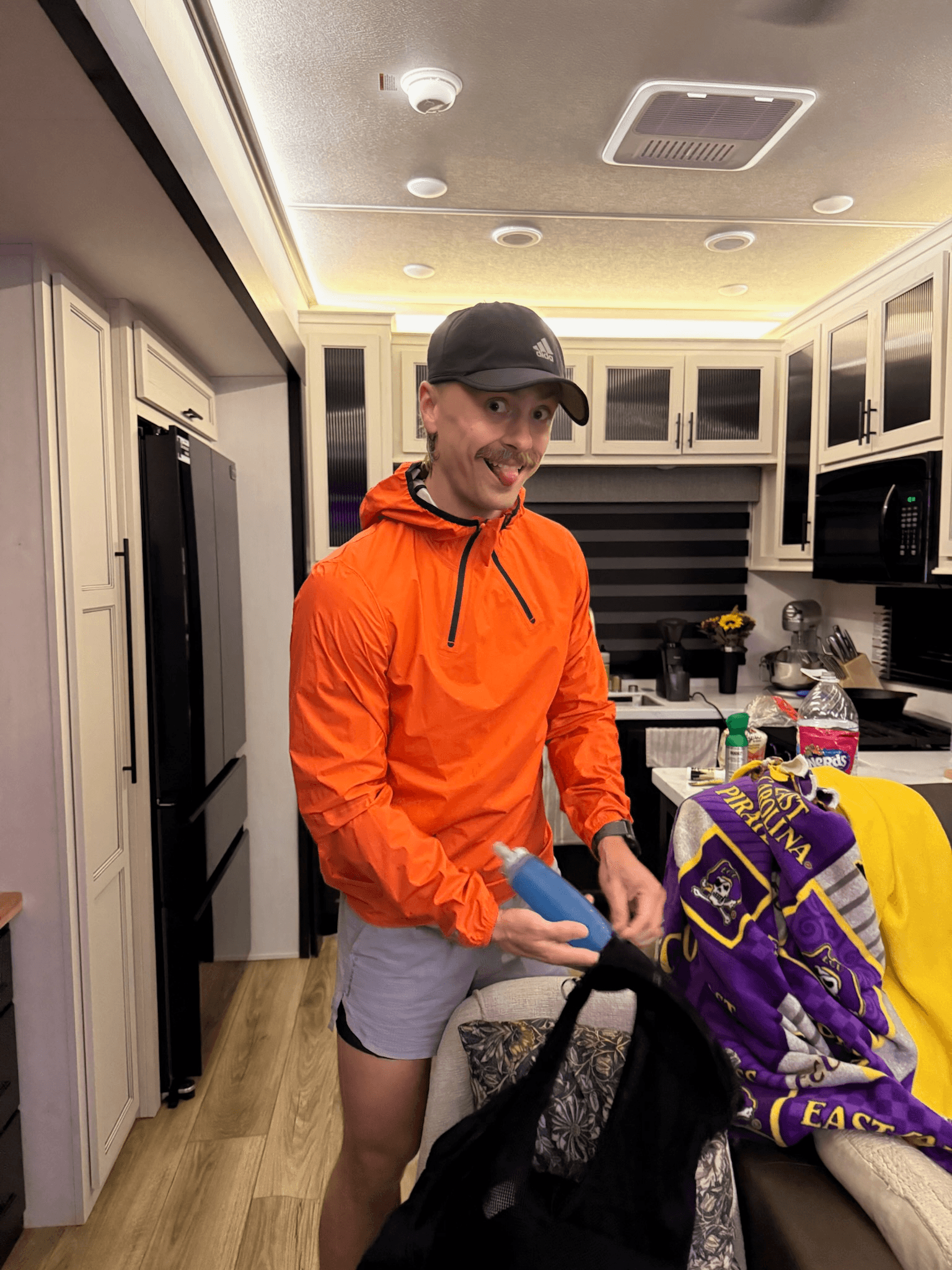
The course got to work immediately. The first mile alone climbed about 250 feet. A little flat, and then straight up. I'd made one decision before the gun that probably saved my entire race: every single time the trail tipped uphill, especially early, the poles came out and I power-hiked it. No heroics, no ego. At Looking Glass I ran climbs I had no business running, and I paid for every one of them later. This time I banked my legs instead, holding a steady 15-minute pace on the climbs, which was exactly what I wanted. Honestly, most of the early grade gave me no choice anyway.
The first stretch was up and over a mountain, back down, then right back up another 500-foot climb. My one genuinely fast split of the whole race came on a screaming descent around mile eight, and even then I was holding back to protect my quads for the back half. I rolled into the mile-eight aid station to find it all lit up in the dark, staffed by volunteers who had set up around 11 PM and were going to be out there until three in the morning for runners they'd never met. You want to walk into a place like that with energy in your voice and a thank-you on your lips. That kind of generosity, at that hour, in that weather, is its own kind of fuel.
The Part Where It Got Peaceful
Miles 10 through 15 were the calmest of the entire day. The course settled onto a stretch of crushed gravel along the Allegheny Trail, the most comfortable running of the whole race, and I fell in with a couple of other runners. For me that little group was pure accountability. Left to my own devices, I drift faster than I should, and these guys helped me hold right around an 11-minute pace through that section. We cruised. It was easy to keep it controlled knowing the biggest climbs were still waiting in the back half, and that everything in the first half was supposed to feel relatively easy.
I also got a lot of time alone out there, and that's honestly half the reason I run these things. Those quiet, dark, early-morning miles turned into some of the best prayer and meditation time I've had in a long while. I had this overwhelming sense of gratitude wash over me out there. Grateful that I get to do this at all, that I have legs that work and the health to use them, that I'd been given an experience like this one in a place I'd never otherwise see. I tried to hold onto that perspective for the whole race, even later when it got dark in a different way. The meditation got interrupted now and then by a 40-degree creek crossing or a slick patch of mud, but that constant change is exactly what made the course feel so alive. You'd be bushwhacking through weeds one minute and crossing a creek the next, climbing and descending and rolling through marshland, and it was beautiful absolutely everywhere you looked.
One small thing I figured out early and kept paying down all race: I'd brought way too much water. The race requires a one-liter minimum, and at Looking Glass I'd once run dry on a long, exposed, sunny stretch, so I'd overcorrected hard. But this was 45 degrees, dark, and pouring rain, and I was carrying close to a liter and a half on my back plus another half-liter up front. I could feel every unnecessary ounce of it. I actually cracked the nozzle and leaked water out of my pack as I ran, just to lighten the load. Lesson filed away for next time: hydrate for the conditions in front of you, not the ones that burned you last time.
Into the Dark, Literally
There's a stretch of this race I won't forget. Somewhere around 3:30 in the morning, deep in that no-service dead zone, the trail dropped me down to the base of a valley, and there in front of me was what looked like a creek. I stopped cold. I checked the route on my watch once, twice, three times. It said forward. The problem was that the "creek" was the trail. The rain had filled it in completely. So there I was, in the pitch black, wading into 40-something-degree water that came up to my waist, walking forward on nothing but faith for a tenth of a mile until I finally spotted a pink course-marking ribbon up ahead and let myself breathe again. That was the only genuinely unnerving moment of the race, and looking back it's one of my favorites.
Running 40 miles through a federally mandated radio-quiet zone in the dark is about as remote as the sport gets, and it's a huge part of why this race is special. No phone. No signal. Just a headlamp, a course marked in pink ribbon, and the occasional far-off glow of the observatory to remind you the rest of the world still exists.
The Long Climb and a Body That Wanted to Quit
Around the marathon mark, the real work began. An eight-mile climb, with the last aid station already eight miles behind me. I'd braced for it to be miserable, and it wasn't, precisely because I'd spent the first marathon banking my legs instead of spending them. I power-hiked the steep pitches and jogged the flats whenever the grade let up, and I watched my splits come in right where I'd planned them, often twenty or thirty seconds faster than my targets without any extra effort. I felt strong on the climbs all day long. All of those slow, controlled, time-on-feet hours I'd put in over the winter were doing exactly what the long run is supposed to do. That told me something I've since taken to heart: I've clearly put a lot of work into my climbing legs, and the thing I now need to train is the descending, because that's where this race eventually took its pound of flesh.
The hardest fight of the whole day came between roughly miles 37 and 45, and it was almost entirely mental. The pain was real, no question, but my body wasn't actually breaking down. It just didn't want to keep going. That's a different thing entirely, and learning to tell the difference between pain you can run through and pain you shouldn't is most of what experience buys you out there. At Looking Glass, this is exactly the moment I would have started walking and never really started running again. This time I made deals with myself instead. I'd hit a runnable flat and tell myself, okay, jog one more quarter mile. Then another quarter. When a quarter felt like too much, I shrank it to a tenth of a mile, then another tenth, bargaining in smaller and smaller increments to keep my feet moving. And it worked. My splits through that stretch held strong, and it was so deeply gratifying to watch my body do the very thing my brain had sworn it couldn't. So much of what was telling me to stop was mental, and we just kept refusing to listen. We never stopped.
The thing that kept the cramps away the entire race was sodium discipline, and it's the clearest sign of how much I've learned since Looking Glass. At every single aid station, the first words out of my mouth were "do you have salt?" One station only had a shaker and not much else, so I grabbed half a banana, absolutely coated it in salt, and ate it, and I felt the difference within minutes. Getting through 40 miles of an ultra with zero muscle cramping, after Looking Glass nearly ended my day on cramps at mile 26, was the entire point of two years of trial and error. That alone made the race a success in my book before I'd even reached the hardest part.
The Airport, and the Worst Stretch
The darkest place I got to mentally was the Airport aid station at mile 45.6, which is also the first point where pacers and crew are allowed onto the course. My feet were in genuine shambles by then. Sharp, shooting pain ran from the soles up through my lower legs with every step, mostly from miles and miles of slick mud and big loose fire-road rock pounding the bottoms of my feet. I had seventeen miles to go, and I knew with total certainty that it was not going to get any easier from there. But I also knew, with that same certainty, that I was going to finish. There was never a question of stopping. I just knew the rest of it was going to hurt.
What came next was the one stretch where the conditions genuinely took something from me that I'd earned. From mile 45.6 down through about mile 55, there's a lot of net downhill, with pitches dropping 400 and 500 feet at a time, the kind of terrain where you should be able to open up and bank a ton of time. But the trail was so caked in mud and so steep that I was grabbing tree trunks to stay upright, picking my way around rocks, more worried about protecting a knee or an ankle than about pace. Some of these were among my slowest miles of the entire race despite being the steepest descents on the course. I was angry out there, honestly. It felt like the rain was robbing me of effort I had banked all day, eating my legs alive for something completely outside my control.
And yet, looking back, it's one of the parts I'm most proud of. It sucked. It was the single worst part of the race, and finishing it the way I did is exactly why I'm glad I went back. Somewhere in there I picked up a runner named Phil around mile 40, and we ended up running most of the back half together. He's a flat-out beast who ate the downhills I was struggling on, and he'd finish a couple of minutes ahead of me, but having someone going through the exact same misery right alongside me made an enormous difference in those miles.
Mile 55: Much Needed Pick-Me-Up
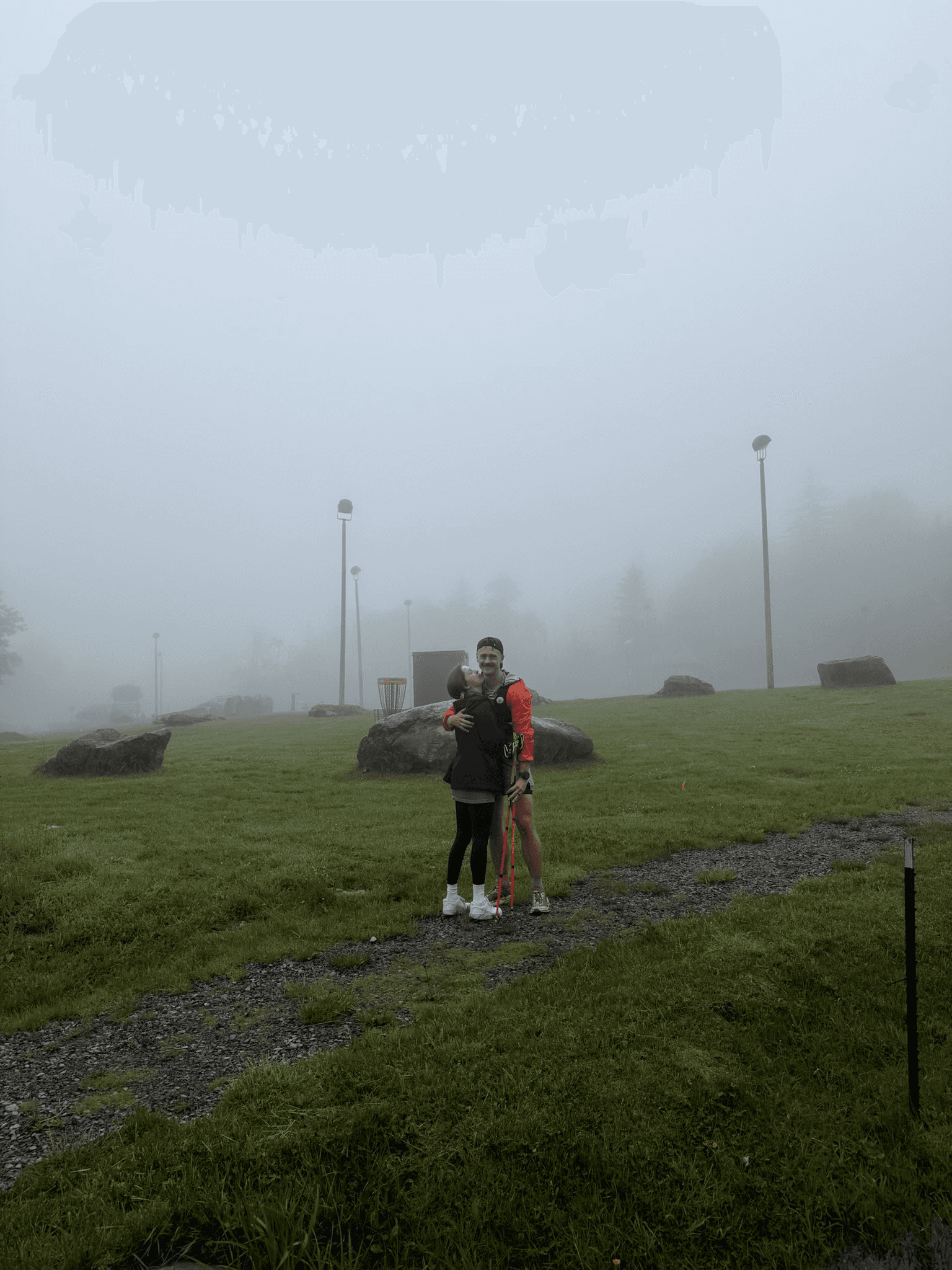
For the last fifteen miles, I had exactly one thought in my head: getting to Old Spruce Brewery at mile 55, where my wife Abby was waiting with my sister-in-law Cassidy. I teared up when I actually saw her. I was in as much physical pain as I've ever been in, and more in need of a lift than I'd ever been in the middle of a race, and seeing her standing there changed the entire complexion of the day for me. But I didn't linger. Staying short at aid stations was one of my explicit goals after the half-hour stops that wrecked my Looking Glass race, so I loaded back up on food, soaked her in for a moment, and got back out onto the course.
There was one big climb left, up to the Bald Knob fire tower around mile 59, then a final muddy descent around Shaver's Lake, and then one last insult: a steep 650-foot climb up the Split Jack ski slope in the final stretch of the race. By that point it was one pole in front of the other, chunking off two-tenths of a mile at a time, turning around to rest my legs, and then grinding out another two-tenths. I crested the slope and saw Adam, Cassidy, and Abby running over to the finish. They'd been down at the brewery and very nearly missed it. I caught my breath at the top, and then I jogged it in.
What the Numbers Actually Mean
The clock read 16 hours, 29 minutes, and change when I crossed. On paper, that's roughly an hour and a half faster than my Looking Glass time. But the paper undersells it. I ran three more miles at Dark Skies than I did at Looking Glass, on my first officially measured 100K, which means the real improvement is closer to two and a half hours, because finishing those extra three miles back at Looking Glass would have cost me at least another hour at the pace I was limping along at. A 14:56 average pace across 62.11 miles and 11,000-plus feet of climbing, in the rain, on a course like that, is a genuine leap from where I was two years ago.
As for the brotherly competition: Adam beat me by about an hour and a half, and I have not heard the end of it since. He ran a sub-eight-hour 50K on that elevation for his first one ever, which is genuinely absurd, and the truth is I was quietly rooting for him to beat me the whole time. If I had beaten him, it would have meant he was hurting badly out there. He crushed it instead, and I couldn't be prouder of him.
The Aftermath
I crossed the line, sat down, and the pain arrived all at once. I couldn't walk. I needed help just to get up onto the bench I'd collapsed onto, and the small rise between where I was sitting and the parking lot looked, and I am not exaggerating even slightly, completely insurmountable. I genuinely thought I might have to be carried to the car. Somehow I came away without a single blister after all that wet, which still amazes me, but my feet were swollen and wrecked for days afterward. The recovery that followed was its own kind of training block, and I respected it more than I ever have before.
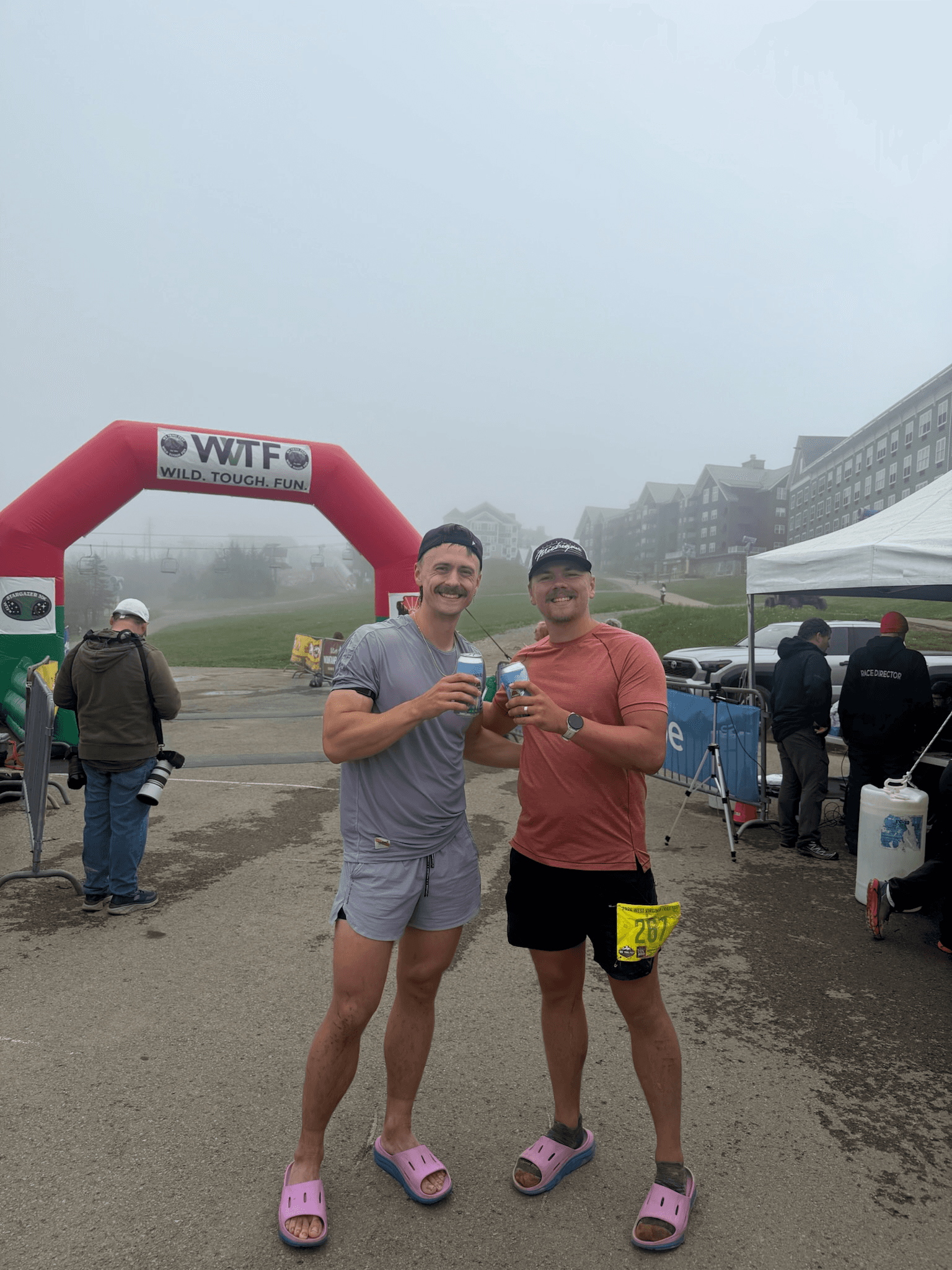
The reward for finishing the 100K was a brand-new USWE racing vest, which they fit me for right there once I could stand. I drank an absurd amount of Red Bull from the sponsor tent, ate a little pepperoni sandwich, and just sat for a while letting it all catch up to me. Back at the campground we showered up, came back to the brewery at the top of the mountain for a drink, and then made homemade blizzards in the RV by throwing ice cream and Oreos into a KitchenAid while we watched the Canes play again. Everyone passed out almost immediately. I slept hard, packed up the next morning still unable to walk properly, and we drove home.
What I Learned, and Why I'll Do It Again
This is the part I actually care about, so I want to slow down on it.
The first thing this race taught me is that the patient plan works. Everything good about my day traces back to a single decision I made before the start and held onto for sixteen hours: come out softer than you think you can, and protect the back half. The power-hiking with poles on every climb, the deliberately slow first marathon, the refusal to chase the fast downhills early. None of it felt heroic in the moment. All of it is the reason I had legs left at mile 50 when two years ago I had nothing left at mile 26. Discipline early bought me everything late.
The second thing is that fueling and sodium are not details. They're the whole foundation. The difference between cramping out at mile 26 and running cramp-free through 40-plus miles wasn't fitness or toughness. It was that I finally understand my own body, that I'm a salty sweater who needs to be aggressive about sodium and consistent about eating, and that I stayed on top of both from the very first aid station instead of waiting until I was already in trouble. If there's one transferable lesson in here for anyone reading, it's that one.
The third thing is the one I have to work on. I am strong going up and I am not yet strong going down. I felt it most in that brutal muddy stretch from 45 to 55, where the descents took more out of me than any climb did all day. Some of that was the conditions, but not all of it. My takeaway is to put real, specific training into descending before the next big one, because on a mountain course the downhills will quietly decide your race.
And the fourth thing is the one I didn't expect. After Looking Glass, I said never again, and I meant it. After Dark Skies, which is now without question the most painful thing I have ever done, I wanted to go back almost before the swelling went down. I think it's because it was so hard. It was something to work through, mentally far more than physically, and working through it is the entire point. Now I've got a number to chase, too. A 14:56 average pace is a target sitting right there, daring me to come back and find 14:30, and then something lower than that.
What's next is a 50K at the end of June, which I almost certainly won't be fully recovered for, but which should be a good time regardless. It's already on the calendar. After that I'm done racing for the summer as my family and I wait on the birth of our first child in August. I got this 100K in the books partly so that I'd have a qualifier in my back pocket if I decide to chase a hundred-miler next spring. That door is still wide open.
Dark Skies was the hardest thing I've ever asked my body to do, and I'd line up for it again tomorrow if my feet would let me. That's about the highest compliment I can pay a race.
